
Cybersecurity Confidence for SMBs in Canada: 3 Practical Steps

As the cyber threat landscape evolves in Canada, small- and medium-sized businesses (SMBs) are increasingly targeted by criminals. This article highlights practical, foundational steps to help SMBs build cyber resilience and confidence.
SMBs are the backbone of the Canadian economy. According to the Government of Canada’s Small Business Statistics 2024, over 98% of all businesses in Canada fall into this category, spanning sectors such as retail, healthcare, professional services, transportation, real estate, construction, and food service. While cybersecurity has traditionally been viewed as a large business priority, the threat landscape has shifted dramatically in recent years.
Attackers are now increasingly targeting smaller businesses because they could have fewer resources, weaker processes, and limited cybersecurity expertise. JPMorgan Chase and Mastercard® understand that in today’s digital economy, SMBs are increasingly vulnerable to cyberattacks.
Mastercard’s latest research, built from over 5000 SMB business leaders across regions and industries identifies common cybersecurity risks and impacts of threats faced by SMBs. According to Mastercard’s 2025 study, 46% have experienced a cyberattack. Moreover, 1 in 5 that do end up filing for bankruptcy or closing business as a result. As Canadian SMBs digitize and integrate cloud technologies, digital payments, remote work tools and online customer engagement platforms, their exposure to cybersecurity risk grows. This article focuses on key trends shaping the cybersecurity environment for SMBs today, followed by actionable steps your business can take to help strengthen resilience.
1. Data breaches and hacking remain top of mind
Hacking and data breaches are the top type of attack experienced by SMBs globally with 32% affected as per Mastercard’s 2025 study. As fraudsters and cybercriminals devise new methods for attacks, it is imperative that your business can identify cyber weaknesses and gaps to proactively implement controls for safety. Attacks can come in many forms, from weak security on a website, to a lack of MFA.
How to Combat:
Implementing multi-factor authentication (MFA) is an easy, actionable step for SMBs for an additional layer of protection. Mandate MFA for email, cloud services, and financial platforms as a first layer of defence.
Additionally, keep systems updated and patch vulnerabilities in your infrastructure quickly. Outdated software remains one of the most common attack vectors, so turning on automatic updates for operating systems, removing unsupported software, and regularly patching vulnerabilities in cloud platforms and third-party tools are crucial to securing your business.
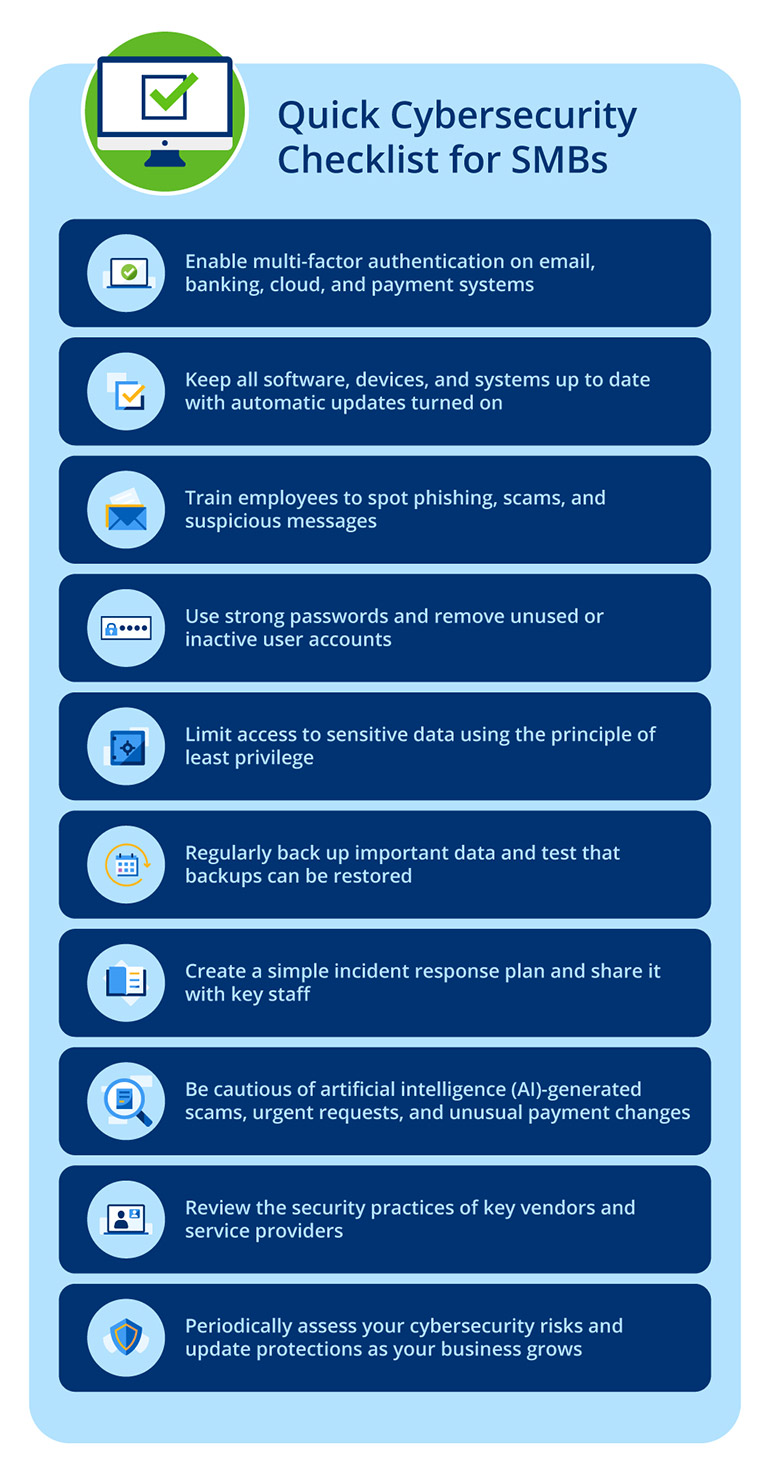
- Enable multi-factor authentication on email, banking, cloud, and payment systems
- Keep all software, devices, and systems up to date with automatic updates turned on
- Train employees to spot phishing, scams, and suspicious messages
- Use strong passwords and remove unused or inactive user accounts
- Limit access to sensitive data using the principle of least privilege
- Regularly back up important data and test that backups can be restored
- Create a simple incident response plan and share it with key staff
- Be cautious of artificial intelligence (AI)-generated scams, urgent requests, and unusual payment changes
- Review the security practices of key vendors and service providers
- Periodically assess your cybersecurity risks and update protections as your business grows
2. Ransomware and extortion attacks are on the rise
According to The Government of Canada, ransomware has continued to be a rising cybersecurity threat, and Canada is no exception. Attackers have shifted to “double extortion” strategies where they not only encrypt an organization’s systems but also steal sensitive information and threaten to leak it if payment is not made. In other words, criminals do two things at once: they lock your systems so you cannot access your data and steal copies of that data so they can demand payment to unlock your systems. The financial and operational impact on SMBs can be devastating, leading to potential downtime, loss of customer trust, and high incident recovery costs. Many SMBs may believe they are too small to be targeted. In reality, over 1 in 8 business report experiencing ransomware attacks in 2023, according to Statistics Canada, 2024
How to Combat:
Limit access to sensitive data by following the principle of least privilege to protect not only your business but your employees. The principle of least privilege is a cybersecurity concept which maintains that your employees should only have access to the data and systems they need to do their job. By keeping access limited, you reduce the risk of mistakes or misuse. This means granting software access only to employees that need it, protecting confidential customer information by limiting access, and regularly checking access to maintain security and protection.
Additionally, create a strong incident response plan that outlines what to do in situations of ransomware to help minimize damage and accelerate recovery during times of distress. Include items like who to contact when an incident occurs, how to isolate the incident, and procedures for documentation and reporting. Run regular exercises and tests to ensure that people know how to respond during a crisis.
A sample incident response plan can look something like: (1) identify the issue and isolate the device (2) notify the right people (e.g., your bank or processor) (3) assess the impact (4) recover and restore the device and apply security fixes (5) report and review the incident to improve.
3. Scammers are getting smarter with AI
Phishing, credential theft, and scams are among the most common and costly cyber incidents affecting Canadians, with over $638 million lost in 2024, according to CTV News, 2025. Criminals running impersonation scams often trick employees into transferring money or revealing confidential information. In many cases, attackers spend time monitoring accounts and gathering details from publicly available business information to craft highly targeted messages, making detection more difficult. With the widespread adoption of generative AI, it is becoming increasingly more difficult to identify a scam, with AI being used to produce highly realistic content, including text, images, video and audio, making it harder and harder to distinguish a scam from the truth.
How to Combat:
As threat actors look to AI to create convincing scams, recognizing AI-generated content is a first step in enabling your employees to identity scams. Look for overly formal language or abnormal text patterns in email communications and texts. For videos, look for abnormal speech patterns, and exercise additional caution in video messages promoting financial opportunities or investments. Recall common tactics used across scams like fear as a motivator, urgent request for personal information, and offers that seem too good to be true.
In conclusion, Canadian SMBs are facing a rapidly evolving cybersecurity landscape. It can be challenging to navigate where to start as a new business owner looking to learn more. By focusing on foundational practices, SMBs can help create sustainable protection against the threats of today and tomorrow. Answer a few simple questions to receive a Cybersecurity Assessment Report, complete with recommendations based on your responses: Cybersecurity Assessment Quiz